

Best Dog Treats for Dogs Taking Medication
Last Updated: November 7, 2026
Quick Summary
The best dog treats for dogs taking medication are soft, chewy, strongly scented treats that can be pressed around a pill, such as cheese, chicken, peanut butter, or beef flavors. Choose a treat small enough to keep your dog's total calories low, and confirm the plan with your veterinarian before you start.
- Treats should stay a small share of daily calories, with most coming from the regular diet.
- Soft, chewy formats work best because they can be pressed around a pill.
- Liquid medication is hard to hide, since soft treats can absorb and drop part of the dose.
- Never crush, split, or open medication unless your veterinarian or pharmacist confirms it is safe.
- If your dog spits out a pill, call your veterinarian rather than giving a second dose.
Table of Contents
- How We Chose These Treats
- Best Food to Hide Pills for Dogs: Our Top Soft Treat Picks
- Dog Treats for Liquid Medicine and Dosing Tips
- Treats for Dogs with Food Allergies and Sensitivities
- How to Give a Dog Medication Without a Fight
- Choosing Your Medication-Time Treat Next Step
- Frequently Asked Questions
Giving a dog a pill is one of the most common challenges pet owners face, and choosing the right one of the best dog treats for dogs taking medication can make it easier or harder. Treats and additional food items should stay a small share of a dog's daily calories, with most coming from the regular diet (Healthy Foods for Happy Dogs). That matters when medication goes into a treat, because every extra bite counts toward your dog's total intake.
K9 Kremery has put together this guide to help you pick treats that hold a pill securely, appeal to picky eaters, and fit the rest of your dog's diet. We focus on soft, chewy options from our own catalog, and we explain where each one works best.
Pill-concealing treats are a recognized product category, and many owners use simple soft foods for the same purpose. The right choice depends on your dog's size, the medication's form, and how quickly your dog notices what is hidden inside.
How We Chose These Treats
We selected treats from our current catalog based on texture, flavor, and how well they suit soft-food use. Our criteria were:
- Texture: Soft and chewy formats that can be pressed around a pill.
- Flavor: Strong, appealing scents such as cheese, bacon, and peanut butter.
- Ingredients: Clear ingredient lists, which matter if your dog has sensitivities.
- Serving practicality: Packaging sizes that suit regular use.
We did not test treats on dogs or claim clinical results. Always confirm with your veterinarian which food is safe to combine with your dog's specific medication.

Best Food to Hide Pills for Dogs: Our Top Soft Treat Picks
Soft treats are a practical choice for soft-food use. Our soft-and-chewy line is a place to start. Our picks below are all made with limited, all-natural preservatives and baked in the USA.
Bocce's Bakery Soft and Chewy Cheese and Chicken Options
Our Soft and Chewy Cheese option is a soft, cheese-flavored treat. It is made with oat flour, cheese, rolled oats, and flaxseed, and sells for $5.99 for a 6 oz bag.
If your dog prefers poultry, our Soft and Chewy Chicken treat is softer than our classic biscuits. Its ingredient list includes oat flour, chicken, rolled oats, and pumpkin, also priced at $5.99 for 6 oz. Our Soft and Chewy Sunday Roast, made with chicken and pumpkin, is priced at $5.99.
For a sweeter option, Bocce's Bakery Dog Training Mud Pie 6oz combines peanut butter and carob, and is priced at $5.99.

Peanut Butter Flavors for Strong-Smelling Coverage
Our Bacon Nutty training bites combine peanut butter and bacon in a soft format. At $5.99 for 6 oz, it is a practical everyday choice. For dogs that respond to beef flavor, our Say Moooo option uses beef and cheddar, also at $5.99.
The soft treats below are all priced at $5.99 for a 6 oz bag, so their cost is easy to compare.
| Treat | Flavor | Price |
|---|---|---|
| Soft and Chewy Cheese | Cheese | $5.99 for 6 oz |
| Soft and Chewy Chicken | Chicken | $5.99 for 6 oz |
| Soft and Chewy Sunday Roast | Chicken and pumpkin | $5.99 |
| Dog Training Mud Pie 6oz | Peanut butter and carob | $5.99 |
| Bacon Nutty training bites | Peanut butter and bacon | $5.99 for 6 oz |
| Say Moooo | Beef and cheddar | $5.99 |
Dog Treats for Liquid Medicine and Dosing Tips
Liquid medication is the hardest form to hide, and the reason is mechanical: a soft treat is a sponge, not a sealed container. A porous crumb absorbs liquid into its air pockets, and when the dog chews, part of the dose can be pressed out and left on the floor, the bowl, or your hand. The practical rule is to match the delivery method to the medication form rather than forcing every dose into a treat.
Tablets and capsules. These are the best fit for a moldable treat. Press the pill into the center of a soft, chewy bite, close the treat around it, and make sure no hard edge is visible. Capsules should be given whole unless your veterinarian or pharmacist has specifically said the contents can be opened, some are designed to release only in the intestine, and opening them can change how the drug is absorbed.
Chewable medications. Many heartworm and flea/tick products are already flavored chews. Do not wrap these in another treat unless your veterinarian approves, because the extra food can reduce how much of the chew the dog actually eats and can interfere with absorption. Offer the chew first, on its own, and follow with a plain treat as a reward.
Liquids. If your veterinarian has approved mixing a liquid with food, confirm the method with your veterinarian before attempting it. Never assume a treat absorbed the full dose, if any liquid drips out, the dose is incomplete.
Crushing and splitting. Do not crush, split, or open any medication unless your veterinarian or pharmacist confirms it is safe. Some tablets are coated to protect the stomach, some are timed-release, and some taste extremely bitter once the coating is broken, a crushed bitter pill can make a dog refuse treats for days.
Confirming the dose. Watch the dog swallow, then check the floor, the bedding, and the dog's mouth for a spit-out pill. If your dog spits out a pill or eats only part of a medicated treat, do not give a second dose on your own, call your veterinarian or an animal poison control service and describe exactly what was and was not swallowed. A partially eaten treat is not a reliable indicator of how much medication was absorbed.
Watch out: some medications must be given with food and others require an empty stomach, and certain foods can affect absorption. Confirm the timing and food instructions with your veterinarian or pharmacist before you build a treat routine around a new prescription.
Treats for Dogs with Food Allergies and Sensitivities
A dog with a medical condition or a prescription diet needs a different decision process than a healthy dog, because the treat is now part of disease management rather than a casual reward. The treat still has to hold a pill, but it also has to fit within the dog's calorie budget and avoid ingredients the dog cannot tolerate.
Start with the calorie math. The widely cited guideline is that treats and extras should stay at or below about 10% of a dog's daily calories, with the rest from the complete diet (Healthy Foods for Happy Dogs). For a dog on a weight-management plan, that 10% can be very small, a few small bites, not a full biscuit. Ask your veterinarian for the dog's daily calorie target and divide the treat allowance across the day so medication-time treats are budgeted, not added on top.
Match the treat to the condition.
- Food allergies and sensitivities: Look for short ingredient lists and a single protein source. Our Freeze-Dried Beef Liver and Lamb Liver treats are single-ingredient products. Each sells for $9.99 for a 3 oz package. Always compare the full ingredient list, not just the front of the bag.
- Pancreatitis or fat-sensitive dogs: Ask your veterinarian before using any treat.
- Kidney disease: Protein and phosphorus levels matter, and a treat that is fine for a healthy dog may not fit a renal diet. Confirm with your veterinarian before adding any treat.
- Diabetes: Confirm any treat and medication schedule with your veterinarian.
- Prescription diets: Some therapeutic diets prohibit all other food. If your dog is on one, ask whether the medication can be given in a small amount of the prescription food itself rather than a separate treat.
Compare before you buy. Treat size, calories per treat, protein and fat content, allergen presence, texture, how much pill the treat can hold, and cost per dose all matter more than flavor claims. A larger bag at a lower price is not a better value if each treat is too big for a small dog or too crumbly to hold a capsule.

Introduce slowly. Offer a small piece of any new treat on a normal day, before you rely on it for medication, and watch for stool changes, itching, or appetite shifts over the next few days. If a reaction appears, stop the treat and call your veterinarian.
Watch out: never swap a prescription diet or change a medication schedule to accommodate a treat. Confirm any treat with your veterinarian first.
How to Give a Dog Medication Without a Fight
Start by offering the treat alone so your dog accepts it without suspicion. Once your dog takes the plain treat eagerly, press the pill inside and offer it again. Keep the process calm and consistent, and reward your dog after the medication is swallowed.
Close-up of a pet owner's hands gently offering a soft, chewy dog treat to a golden retriever sitting calmly on a kitchen floor
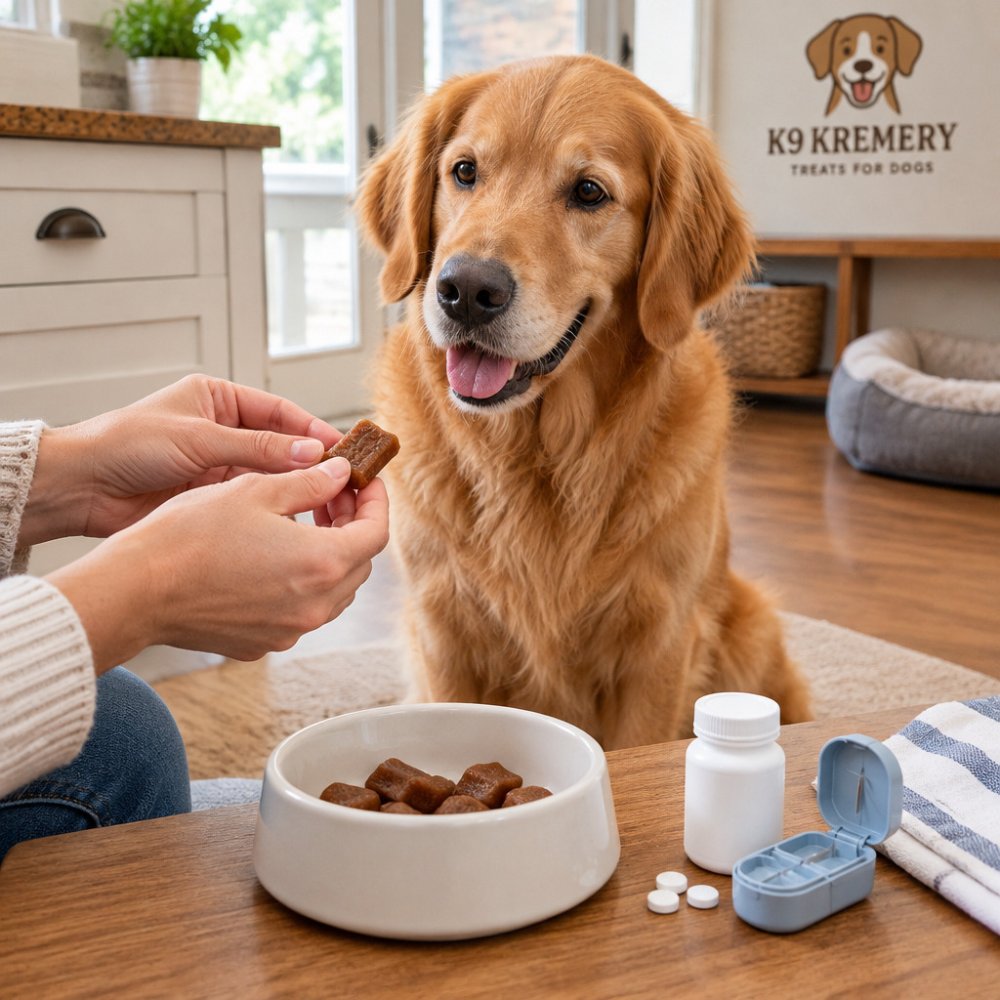
If your dog is picky, avoid making the treat the only food. Offer the medication-treat as part of the normal routine, and if the dog refuses, do not force it. The treats your dog already enjoys are often the easiest to use. Ask your veterinarian about alternative formats, such as liquid or compounded versions.
Choosing Your Medication-Time Treat Next Step
Pick a soft, strongly scented treat that matches your dog's taste, keep the treat small, and confirm the plan with your veterinarian. Our soft-and-chewy range from K9 Kremery covers cheese, chicken, peanut butter, and beef options. Shop the soft and chewy collection at K9 Kremery to find the flavor your dog will take without a fight.
Frequently Asked Questions
What are some good treats to give my dog medicine in?
Soft, moldable treats work best because they hold a pill securely and are easy to shape around it. Bocce's Bakery Soft and Chewy treats, sold through K9 Kremery at $5.99 for a 6 oz bag, are soft, chewy treats. Always check that the treat is safe for your dog's diet and that the amount fits within your dog's daily treat allowance. Ask your veterinarian which option suits your dog's specific medication.
What is the safest brand of dog treats?
Safety depends on ingredients, manufacturing standards and your dog's individual needs rather than brand reputation alone. Look for treats with a short, recognizable ingredient list and clear labeling. The Bocce's Bakery line sold by K9 Kremery is described as wheat-free and made with real ingredients, baked in the USA. Check with your veterinarian before introducing any new treat, especially if your dog has a medical condition.
How do I trick my dog to take his medication?
Wrap the pill in a small, soft treat and offer it before your dog is hungry enough to refuse. Keep the treat small so your dog eats it quickly. If your dog spits out or picks around the pill, do not force it; contact your veterinarian for alternative formulations. Consistent timing and a calm environment help dogs accept medication more easily.
What food can I give my dog with medicine?
Some medications need to be given with food and others on an empty stomach, so confirm this with your veterinarian or the pharmacy label. Treats used to hide medication should count toward your dog's daily intake. Keep treats and extra food to a small share of daily calories, with most coming from the regular diet. Plan treat portions accordingly.
