

How to Measure Salmon Dog Food Portions by Weight
Last Updated: November 21, 2026
Quick Summary
Set salmon dog food portions by starting with your dog's body weight, then adjust for age, activity, and body condition. Divide the daily amount into two meals and recalculate whenever you switch formulas, since calorie density differs between salmon foods.
- A 40 lb dog eating roughly 400 kilocalories per cup needs near 2 cups daily, split into two 1-cup meals.
- Cut or add about a tenth of the daily amount, then wait two to three weeks before changing again.
- Divide your dog's daily calorie target by the food's kilocalories per cup or can to get units per day.
- Puppies often eat three or four smaller meals a day and should follow their formula's own puppy chart.
- Neutered dogs often need fewer calories than intact dogs of the same weight.
Table of Contents
- Why Salmon Portions Need a Weight-Based Starting Point
- Using a Salmon Dog Food Portion Size by Weight Calculator
- Dog Feeding Chart by Weight and Age for Salmon Food
- How Much Wet Food to Feed a Dog by Weight
- How to Measure Dog Food Portions Accurately
- Adjusting Salmon Portions for Body Condition and Neuter Status
- Reading Salmon Dog Food Labels Before You Scoop
- Ordering Salmon Dog Food for Your Dog's Portion Plan
- Frequently Asked Questions
Why Salmon Portions Need a Weight-Based Starting Point
Every calculation of salmon dog food portions starts with a number: your dog's weight. A weight-based starting point gives you a safe, sensible amount to feed before you fine-tune anything else. A weight-based number is best treated as a baseline, not a final answer.
Why does it matter so much? Because portion size changes how much a dog eats, and the effect is real. A repeated-measures feeding study published in PubMed Central found that dogs ate more when served larger portions, even when the food was the same. Give a bigger scoop, and most dogs will finish it.
- Salmon is rich and tasty, so dogs rarely self-limit
- Free-pouring leads to slow, unnoticed weight gain
- A number on the bag is a starting point, not a target
- Body weight, age, and activity all shift the right amount
Salmon dog food portion size by weight is the practice of setting a daily food amount based on your dog's body weight, then adjusting it for age, activity, and body condition. It gives you a repeatable method instead of a rough eyeball estimate.
Below, we'll show you how to calculate a daily allowance, split it into meals, and adjust it as your dog changes.
Using a Salmon Dog Food Portion Size by Weight Calculator
A calculator is the fastest way to get a starting number. You enter your dog's weight, and it returns a daily food amount based on calorie needs.
- Weigh your dog. Use a vet scale or a home scale you can hold your dog on.
- Estimate resting energy. A common formula multiplies body weight in kilograms by about 70, raised to the power of 0.75.
- Apply a life-stage factor. Neutered adults need less; active or growing dogs need more.
- Divide by food calories. Check the kilocalories per cup or can on the label.
- Round to a practical scoop. Whole cups and half cups are easier to repeat daily.
Many owners skip the calculator and use the bag chart instead, which works as a first pass. The calculator earns its keep when your dog sits between two weight ranges or has gained a little weight.
One caveat: no calculator knows your individual dog. Treat its output as a starting point and watch your dog's body condition over the next few weeks.
Dog Feeding Chart by Weight and Age for Salmon Food
A feeding chart by weight and age gives you a quick reference range, but a salmon chart is only useful if it is tied to the calories in salmon food.
Here is a general reference for adult dogs eating a typical salmon dry food at about 400 kilocalories per cup.
| Dog Weight | Daily Amount (dry, ~400 kcal/cup) | Meals per Day | Notes |
|---|---|---|---|
| 5-10 lb | 1/4 to 1/2 cup | 2 | Small breeds, watch weight closely |
| 10-25 lb | 1/2 to 1 1/4 cups | 2 | Adjust for activity |
| 25-50 lb | 1 1/4 to 2 cups | 2 | Most common range |
| 50-75 lb | 2 to 2 3/4 cups | 2 | Split evenly |
| 75-100 lb | 2 3/4 to 3 3/8 cups | 2 | Larger meals, slower eating |
| 100-125 lb | 3 3/8 to 4 cups | 2 | Giant breeds need monitoring |
Take a 40 lb dog. At roughly 400 kilocalories per cup, its daily energy need lands near 2 cups of dry salmon food, split into two 1-cup meals.
Puppies are different. They need more calories per pound and often eat three or four smaller meals a day.
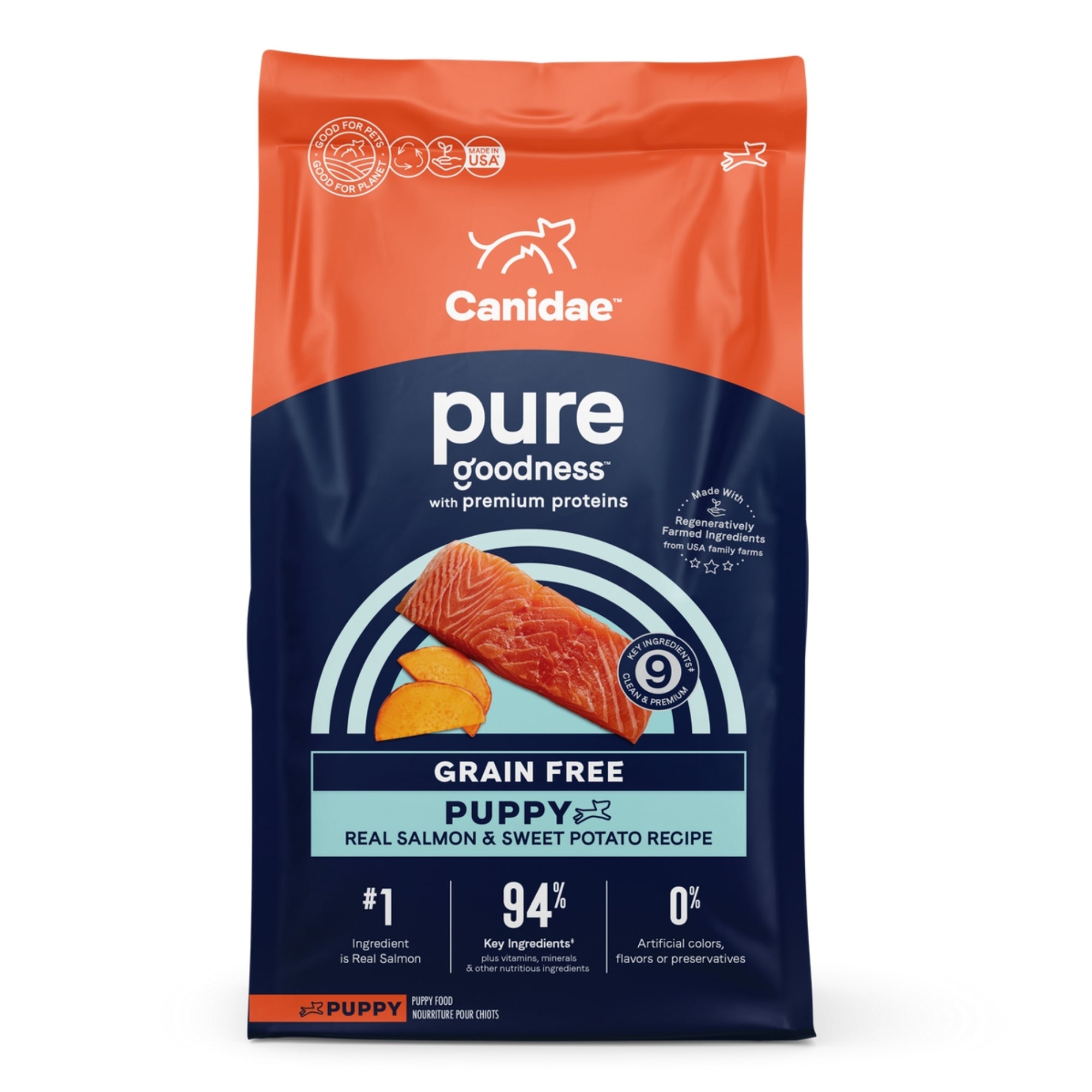
If you are feeding a puppy, a salmon puppy formula with a matching bag chart is the safest starting point. For example, the Canidae Pure Goodness Grain Free puppy food in salmon and sweet potato gives you a bag chart built for growing dogs.
For adult dogs, a salmon and whitefish option like Grandma Maes Salmon & Whitefish Meal dry dog food pairs a printed chart with a fish-first recipe.
Watch out: a chart built for one salmon food does not transfer cup-for-cup to another, because calorie density and kibble size differ. Recalculate whenever you switch formulas.
How Much Wet Food to Feed a Dog by Weight
Wet food follows a different scale because it contains far more water. A can of salmon wet food weighs much more than the same calories of kibble.
Most wet foods give a simple rule on the can, such as one can per set number of pounds of body weight per day. Follow that rule first, then adjust.
- Volume is higher. Water weight means bigger servings for the same calories.
- Calories are lower per ounce. Check kilocalories per can, not per cup.
- Mixing needs math. When you combine wet and dry, reduce the dry amount to avoid overfeeding.
- Storage matters. Refrigerate opened cans and use them within a couple of days.
If you feed a small salmon wet or air-dried food, portion by weight and use the serving guidance on the package. A small-format option like Rawternative air dried salmon and beef makes it easy to measure out a precise serving for a smaller dog.
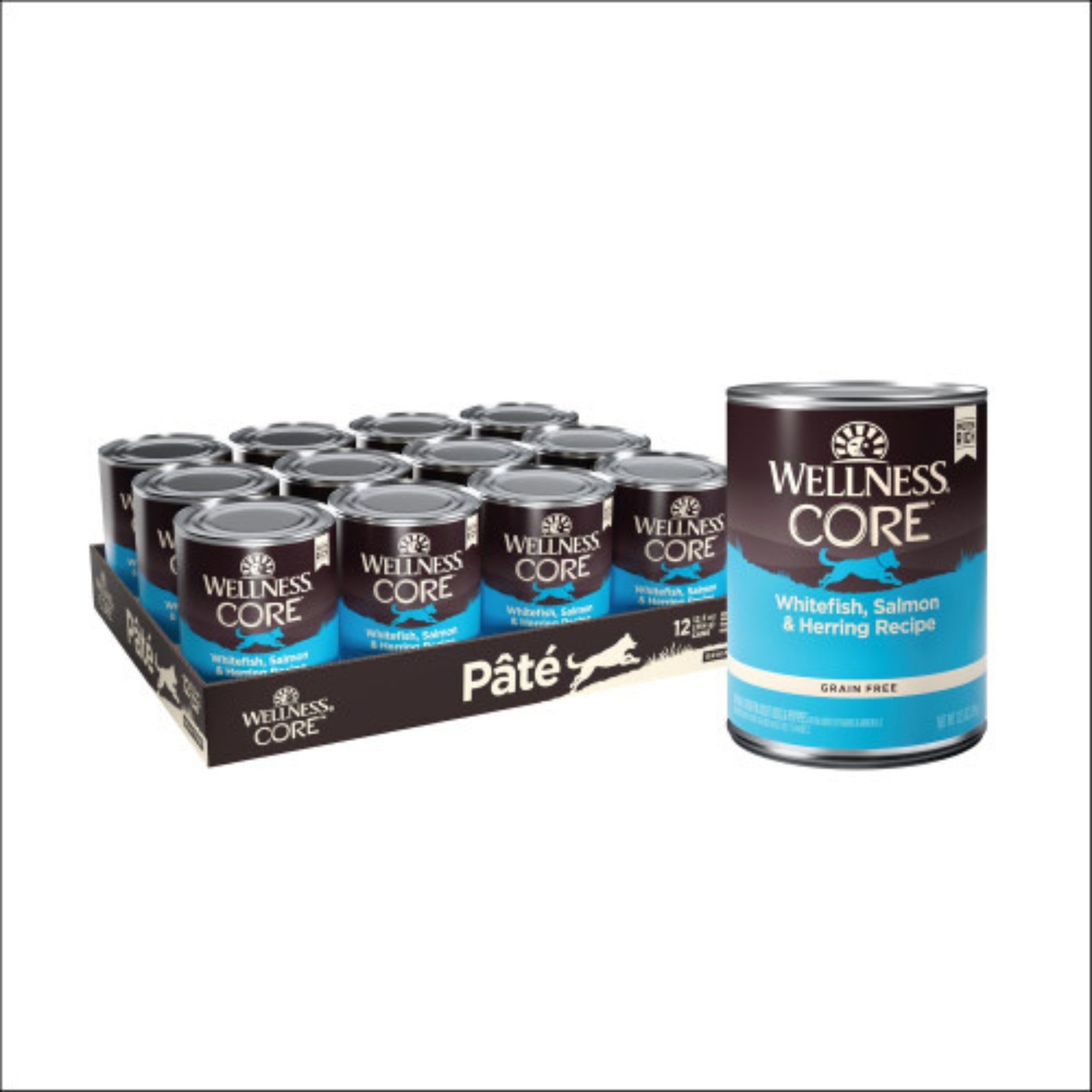
For a full wet food plan, the Wellness CORE whitefish, salmon, and herring wet food lists an adult feeding guideline. Start there, then adjust.
How to Measure Dog Food Portions Accurately
Accurate measuring comes down to three tools: a scoop, a scale, and consistency. Guesswork is the enemy here.
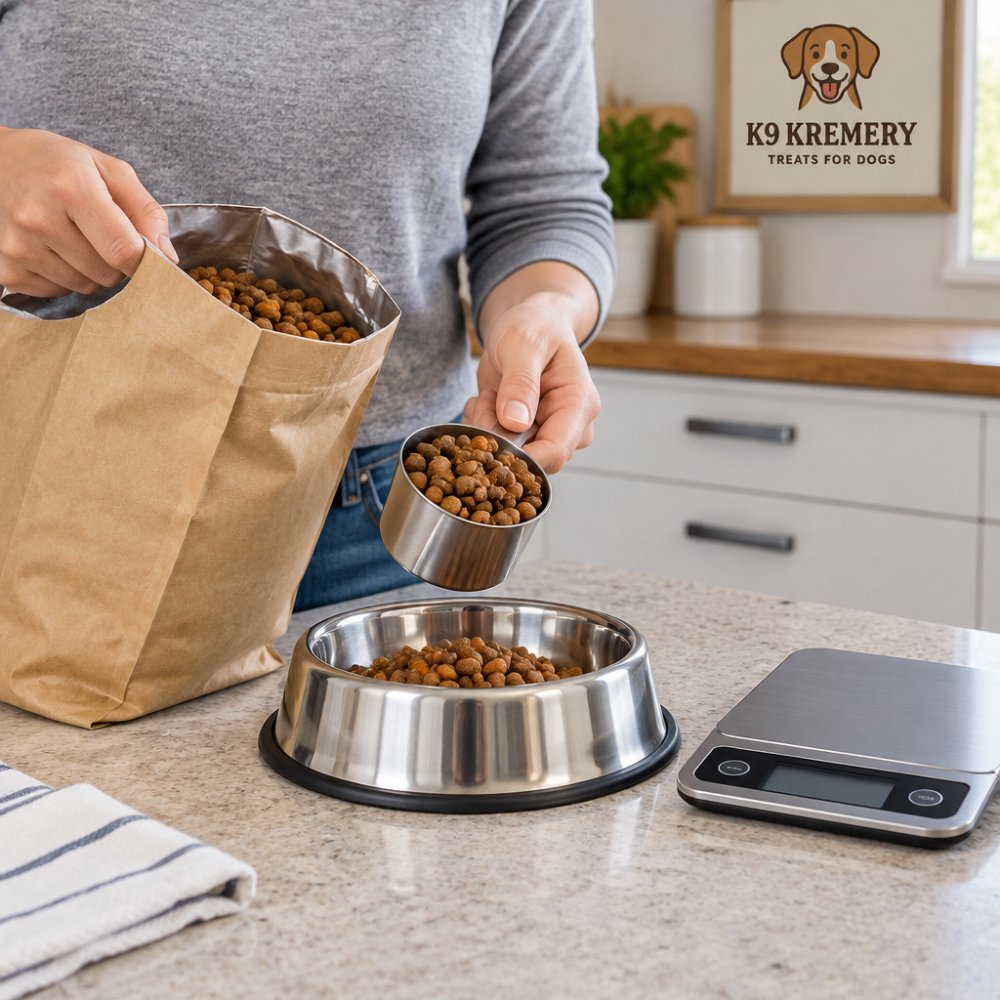
- Use a real measuring cup, not a coffee mug or a random scoop.
- Level the scoop with a flat edge so each cup is the same.
- Weigh the food occasionally to confirm your cup matches the label's grams or ounces.
- Scoop the same way every time. Packed versus loose kibble changes the amount.
- Split the daily total into meals before you scoop, so you don't double up.
A proper measuring scoop removes the guesswork. Our Van Ness Food Scoop Regular is a simple, sturdy option that gives you the same measure every meal.
Watch out: switching foods without recalculating portions can change how much your dog eats. New food, new calories, new number.
Adjusting Salmon Portions for Body Condition and Neuter Status
Body condition is a hands-on check. Run your palms along your dog's ribs. You should feel them easily under a thin layer of fat, and see a waist from above. If ribs are hard to find, cut the portion slightly. If they feel sharp, add a little.
Neuter status matters too. Neutered dogs often need fewer calories than intact dogs of the same weight.
- Sedentary dogs: stay at the lower end of the range
- Moderately active dogs: use the middle of the range
- Working or sport dogs: feed toward the upper end
Adjust your salmon dog food portions in small steps. Cut or add about a tenth of the daily amount, then watch for two to three weeks before changing again. Rapid swings upset digestion and make it hard to judge what worked.
Reading Salmon Dog Food Labels Before You Scoop
The label is your best source for the right portion, but only if you read the right lines and then do one small calculation.
- Guaranteed analysis: crude protein, fat, fiber, and moisture percentages
- Calorie content: kilocalories per cup, can, or kilogram
- Feeding directions: the weight-based chart for your dog's size
- Life-stage statement: puppy, adult, all life stages, or senior
- First ingredients: salmon or salmon meal should lead for a salmon formula
The calorie line is the one people skip, and it lets you convert a general calorie target into a product-specific portion through simple division.
- Find the kilocalories per cup, can, or pouch. Dry food usually lists kilocalories per cup and per kilogram. Wet food usually lists kilocalories per can or per pouch.
- Estimate your dog's daily calorie target. A common starting point for a neutered adult is roughly 30 times body weight in kilograms plus 70, then adjusted down for sedentary dogs and up for active ones. Your veterinarian can refine this.
- Divide the target by the food's calories. If your dog needs about 800 kilocalories a day and the salmon kibble is 400 kilocalories per cup, the daily portion is 2 cups. If a salmon wet food is 400 kilocalories per 12.5 oz can, the daily portion is 2 cans.
- Convert to meals. Split the daily total into two meals, so 2 cups becomes 1 cup twice a day.
- Round to a practical measure. Whole and half cups, or half cans, are easier to repeat than odd fractions.
That is the whole trick: calories needed divided by calories per unit equals units per day.
The label also tells you whether the food is complete and balanced. A complete-and-balanced salmon food is a full diet.
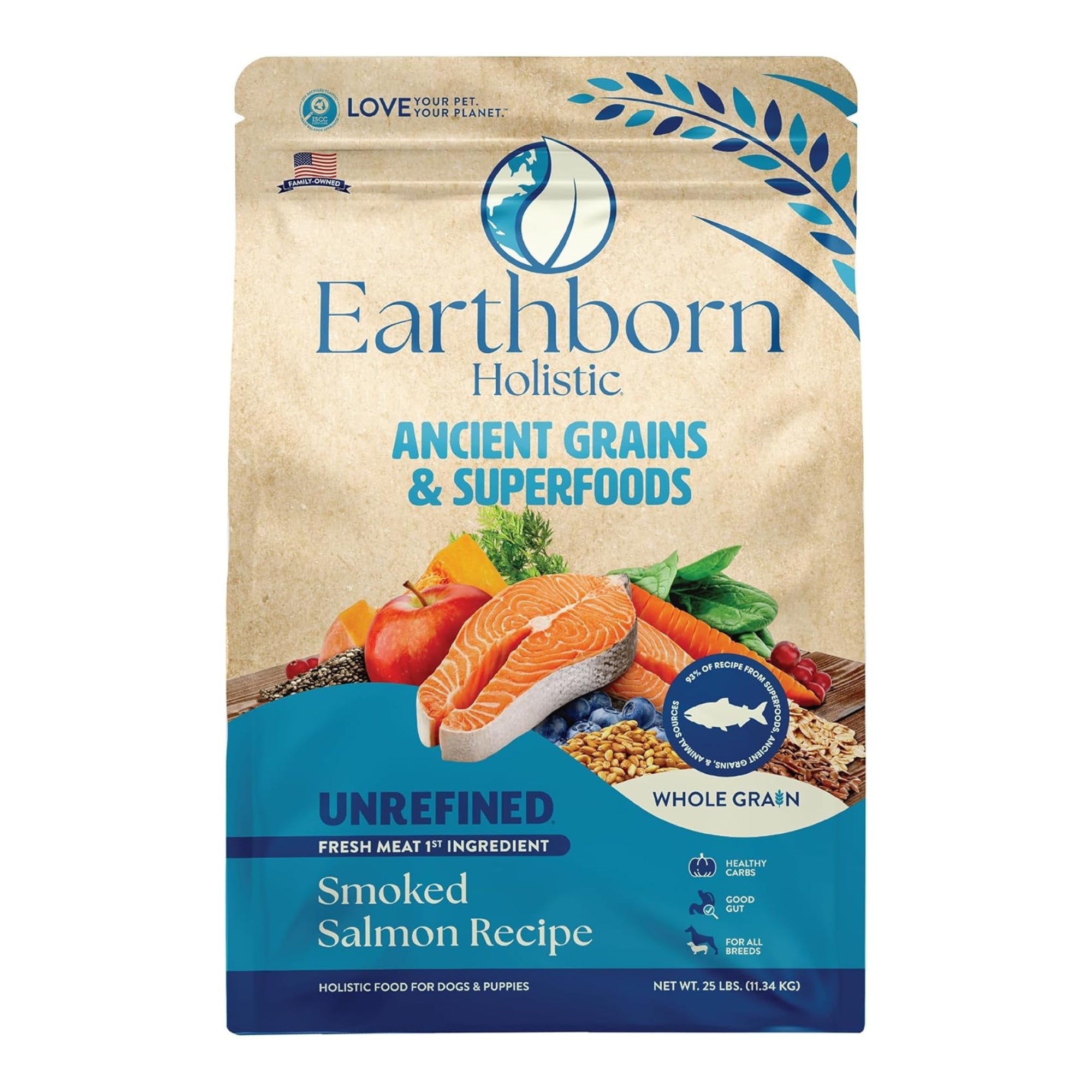
For a full-size salmon dry food with clear feeding guidance on the bag, the Earthborn Holistic Unrefined salmon recipe gives you a label you can work from directly.
Watch out: kilocalories per kilogram and kilocalories per cup are not interchangeable without the food's density, so use the per-cup figure for dry food and the per-can figure for wet food rather than mixing units.
Ordering Salmon Dog Food for Your Dog's Portion Plan
Once you know your dog's daily amount, match the bag size to how fast your dog eats through it, so the food stays fresh.
A simple way to plan:
| Dog Size | Daily Amount | 4 lb Bag Lasts | 25 lb Bag Lasts |
|---|---|---|---|
| Small (under 15 lb) | ~1/2 cup | ~3-4 weeks | ~5 months |
| Medium (25-50 lb) | ~1 1/2 cups | ~1-2 weeks | ~2-3 months |
| Large (75+ lb) | ~3 cups | Under a week | ~4-6 weeks |
Salmon foods are a smart pick for many dogs. Fish is relatively low in saturated fat, and it can suit dogs with chicken sensitivities. That makes a measured salmon portion a practical tool for weight management, not just a tasty meal.
At K9 Kremery, we stock salmon dry foods, wet foods, and small-format options so you can build a portion plan around your dog's weight and taste. Order online today and treat your pup to a meal that fits.
Getting the portion right takes a little math and a little watching, but it pays off in a dog that holds a healthy weight for years.
Frequently Asked Questions
How much salmon dog food should I feed my dog by weight?
Start with the package feeding chart for your dog's current weight, then compare it to a calorie estimate. Calorie needs vary by dog, so check with your veterinarian for a specific daily target. If your salmon kibble has about 400 calories per cup, that works out to roughly 1.75 to 2.25 cups daily, split into two meals. Use body condition checks every two weeks to fine-tune the amount up or down.
Is there a salmon dog food portion calculator?
Yes. A simple calculator estimates your dog's daily calorie needs from its weight, then divides by the food's calories per cup or can. Check the guaranteed analysis on your salmon food label for the calorie count, then divide to get cups or cans.
How do I adjust salmon dog food portions for my dog's age and activity level?
Puppies need more calories per pound for growth, so follow the feeding guidance on the product label. Senior and sedentary dogs usually need fewer calories, so reduce portions gradually and monitor weight. Active dogs may need more. Recheck body condition monthly and adjust in small steps rather than large jumps.
How much wet salmon dog food should I feed my dog?
The Wellness CORE Whitefish Salmon Herring Recipe feeding guidelines recommend 1 can per 15 pounds of body weight per day for adults. A 30-pound dog would get 2 cans daily, split into two meals. If you mix wet with dry, reduce the dry amount by about 1/2 cup for every 6 ounces of wet food to avoid overfeeding.
