

What Human Foods Can Dogs Eat Safely?
Last Updated: October 26, 2026
Quick Summary
Dogs can safely eat many human foods for dogs, including plain cooked lean meats, eggs, apples, bananas, blueberries, carrots, green beans, pumpkin, and sweet potatoes. Foods must be plain, unseasoned, and stripped of pits, seeds, stems, and peels. Keep treats under roughly 10% of your dog's daily calories.
- Wash all fruits and vegetables, remove pits, seeds, and stems, and cut into bite-sized pieces.
- Boil, bake, or grill meats with no salt, oil, butter, or seasoning.
- Find your dog's daily calorie target using RER = 70 × (body weight in kg)^0.75.
- Chocolate, grapes and raisins, onions and garlic, xylitol, alcohol, macadamia nuts, and caffeine are toxic to dogs.
- Do not induce vomiting unless a veterinary professional tells you to.
Table of Contents
- What Human Foods Can Dogs Eat? The Short Answer
- Safe Fruits and Vegetables for Dogs
- Lean Meats, Eggs, and Other Protein Sources
- How Much Human Food Can Dogs Eat? Portions by Size and Calories
- Human Foods Toxic to Dogs (and What to Do After Ingestion)
- Healthy Snacks for Dogs: Prep Rules, Life Stage, and Health Cautions
- Stock Your Treat Jar with Dog-Safe Snacks
- Frequently Asked Questions
What Human Foods Can Dogs Eat? The Short Answer
Most dog owners want a straight answer, so here it is: dogs can safely eat many human foods, including plain cooked lean meats, eggs, apples, bananas, blueberries, carrots, green beans, pumpkin, and sweet potatoes. The catch is preparation.
That gap between "safe food" and "safe serving" is where most accidents happen. A 2016 U.S. survey found that only 3% of dog owners reported purchasing raw pet food, yet human food sharing is far more common than commercial raw feeding (Davies et al. review of raw diets for dogs and cats(https://pmc.ncbi.nlm.nih.gov/articles/PMC6849757/)).
Below, we break down the safe list, the toxic list, portion math, and what to do if your dog eats something dangerous.
One rule frames everything else. Human foods are treats, not meals. The FDA's pet food guidance(https://www.fda.gov/animal-veterinary/animal-food-feeds/pet-food) is clear that animal foods must be safe and nutritionally complete, and a handful of carrots does not meet that bar.
Safe Fruits and Vegetables for Dogs
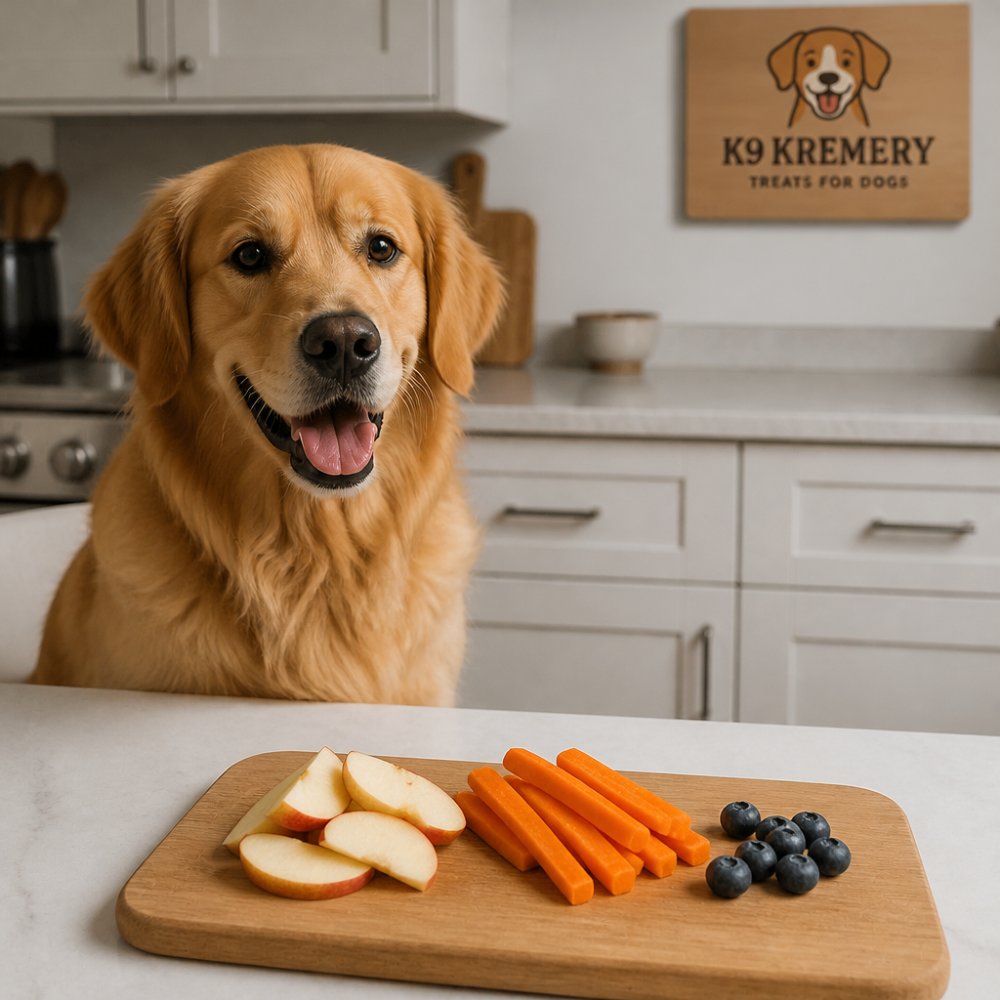
Fruits and vegetables are one option for human foods for dogs. The non-negotiable prep rule: wash everything, remove pits, seeds, and stems, and cut into bite-sized pieces.
Fruits: Apples, Bananas, Blueberries, and More
Apples are safe but the core and seeds are not, so slice around them. Bananas work in small pieces because of their sugar load. Blueberries are a genuine standout: small, antioxidant-rich, and easy to scatter as a reward. Cranberries are fine fresh or dried, though dried versions often carry added sugar.
Vegetables: Carrots, Green Beans, Pumpkin, and Sweet Potatoes
Carrots give crunch and chew time. Green beans, plain and unseasoned, suit dogs watching their weight. Pumpkin supports digestion, but only plain canned pumpkin, never pie filling. Sweet potatoes must be cooked and plain, never raw.
If you would rather skip the prep, our Apple Bits dog biscuits are made with real applesauce, cinnamon, and parsley, and our sweet potato chips for dogs are made from non-GMO sweet potatoes.


Lean Meats, Eggs, and Other Protein Sources
Chicken, turkey, beef, and fish should be boiled, baked, or grilled with no salt, oil, butter, or seasoning. Cooked eggs are an excellent protein source, scrambled or hard-boiled and unseasoned.
Fish earns a caution: remove all bones, and avoid fish packed in oil or brine. Raw meat carries bacterial risk, which is why the microbiological review of raw diets flags pathogens as the central concern with uncooked animal foods (Davies et al., microbiological hazards of raw diets(https://pmc.ncbi.nlm.nih.gov/articles/PMC6849757/)).
A common mistake is assuming "plain" means "no sauce." It means no ingredients beyond the meat itself.
How Much Human Food Can Dogs Eat? Portions by Size and Calories
The safe ceiling is simple: treats should stay under roughly 10% of your dog's daily calories, with the rest coming from a complete and balanced diet. That 10% figure is standard veterinary guidance, and it scales with body size. What most lists skip is how to actually apply it, so here is the working method.
Step 1: Find your dog's daily calorie target
Start with resting energy requirement (RER), the formula veterinarians use as a baseline: RER = 70 × (body weight in kg)^0.75. To convert pounds to kilograms, divide by 2.2. Then multiply RER by a life-stage factor: about 1.6 for a neutered adult, 1.8 for an intact adult, 3.0 for a puppy under four months, and 1.2-1.4 for a senior or weight-loss dog. A 30 lb dog is about 13.6 kg; 70 × 13.6^0.75 ≈ 490 calories RER, and at a 1.6 factor that is roughly 780 calories per day. Your vet can refine this for body condition score, but the formula gets you in the right neighborhood.
Step 2: Convert the 10% treat budget into food amounts
Once you have the daily calorie target, multiply by 0.10. That is the total calorie allowance for all treats, human food and commercial treats combined. Then divide by the calorie density of the food you are feeding. A medium carrot is about 25 calories, a cup of plain green beans about 30, a cup of blueberries about 80, and a large hard-boiled egg about 70.
| Approx. Daily Calories | Treat Budget (10%) | Example Serving |
|---|---|---|
| 300-500 | 30-50 | 3-4 small carrot coins or 1/4 cup green beans |
| 500-900 | 50-90 | 1/4 apple, sliced, or 1/2 cup plain pumpkin |
| 900-1,400 | 90-140 | 1/2 apple plus a few berries, or 1 egg |
| 1,400-2,000 | 140-200 | 3/4 apple plus a handful of green beans |
These are working estimates, not prescriptions. Your vet can calculate exact needs based on weight, age, and activity.
Homemade Dog Treats -🍏 Apple Bits Dog Biscuits 1/2 lb. →
Step 3: Account for every treat, not just the obvious ones
The 10% cap covers everything outside the main diet: training rewards, dental chews, table scraps, and the biscuit your dog gets before bed.
Step 4: Adjust for life stage and body condition
Puppies need more calories per pound for growth but have smaller stomachs, so split the treat budget into more, smaller servings. Seniors often need fewer calories and benefit from lower-fat options like plain green beans or pumpkin.
Portion size is the single most overlooked variable in the human food conversation, and it is why a "safe" food can still cause digestive upset in a small dog. A treat that is harmless in a 90 lb dog can be a meal's worth of calories in a 10 lb dog.
Human Foods Toxic to Dogs (and What to Do After Ingestion)
Chocolate, grapes and raisins, onions and garlic, xylitol-sweetened products, alcohol, macadamia nuts, and caffeine top the list. Xylitol is especially dangerous because it hides in sugar-free gum, peanut butter, and baked goods. Apple seeds and cherry pits contain cyanide compounds, which is why removal matters even for otherwise safe fruits.
Here is the sequence.
Step 1: Identify what was eaten and how much
Gather the packaging, the wrapper, or a photo of the label. Note the product name, the ingredient list, and the approximate amount consumed. For xylitol, the concentration varies by product, so the label is the most useful thing you can hand your vet.
Step 2: Estimate the dose relative to your dog's weight
Toxicity is a function of amount per pound of body weight, not amount alone. A single grape can be a problem for a 10 lb dog and a minor exposure for a 90 lb dog. The same logic applies to chocolate: theobromine thresholds are commonly cited in milligrams per kilogram of body weight, so a small dog eating a small amount of dark chocolate can cross the line that a large dog would not. You do not need to do the math yourself, give the vet the amount and the weight and they will run it.
Step 3: Call for guidance before symptoms appear
Call your veterinarian, an emergency veterinary hospital, or a pet poison hotline immediately. Do not wait for vomiting, tremors, or lethargy, by the time symptoms appear, the window for the least invasive treatment may already be closing. Xylitol, in particular, can cause a rapid blood sugar crash, and the window for treatment is short. Treat any suspected exposure as an emergency.
Step 4: Do not induce vomiting unless told to
Inducing vomiting is not a home remedy. It is contraindicated for some exposures (caustics, sharp objects, certain hydrocarbons) and can cause aspiration pneumonia if done incorrectly. Follow the instructions you are given, and only induce vomiting if a veterinary professional tells you to.
Step 5: Bring the evidence and watch for delayed signs
Bring the packaging, any vomit, and a note of the time of ingestion to the clinic. Some toxicities, grapes and raisins among them, can cause kidney injury that shows up hours to days later, so a dog that looks fine at hour two still needs monitoring. Your vet will tell you what to watch for and when to recheck.
Foods to keep out of reach entirely
- Chocolate, especially baking and dark chocolate
- Grapes and raisins, including in baked goods and trail mix
- Onions, garlic, leeks, and chives, including powders in seasoned human food
- Xylitol, gum, sugar-free candy, some peanut butters, and baked goods
- Alcohol, including in unbaked dough and some desserts
- Macadamia nuts
- Caffeine, coffee, tea, energy drinks, and some supplements
Healthy Snacks for Dogs: Prep Rules, Life Stage, and Health Cautions
- Cook plain: no salt, oil, butter, garlic, or onion powder.
- Remove hazards: pits, seeds, stems, peels, and bones.
- Cut small: choking risk rises with size.
- Introduce one at a time: a new food every few days makes reactions easy to trace.
- Watch the sugar: bananas and dried fruit add up fast.
For a deeper list, our guide to the best natural snacks for dogs covers more options, and owners managing digestion issues should read our picks for dog treats for sensitive stomachs.
Stock Your Treat Jar with Dog-Safe Snacks
K9 Kremery offers natural treats, birthday cake kits, and dog-friendly ice cream mixes. If you want to learn more about dog treats, our explainer on why choose human-grade dog treats walks through the standard.
Frequently Asked Questions
Can dogs eat cooked chicken, eggs, or rice?
Yes, all three are safe when prepared plainly. Cook chicken without skin, salt, or seasoning, and make sure it is fully cooked. Scrambled or hard-boiled eggs are fine as long as they are cooked through with no butter or salt added. Plain white rice is easy to digest and often used as a bland base. Keep portions small: a few tablespoons of chicken or rice and one egg suit most medium dogs. These foods work as toppers or treats, not as a replacement for a complete and balanced diet.
What human foods are toxic to dogs?
Chocolate, grapes and raisins, onions, garlic, xylitol (a sweetener in sugar-free gum and some peanut butters), alcohol, caffeine, and macadamia nuts are the most common toxic foods. Symptoms range from vomiting and diarrhea to seizures and organ damage. If your dog eats any of these, call your veterinarian or a pet poison hotline right away. Do not wait for symptoms. Note what was eaten and how much, and bring the packaging if you have it.
How much human food can I give my dog each day?
Treats, including human food, should stay under about 10 percent of your dog's daily calories. For a 20-pound dog eating roughly 500 calories a day, that is about 50 calories, or a few small apple slices and a tablespoon of plain chicken. Large dogs can handle more, but the 10 percent rule still applies. Cut human food into small pieces and subtract it from regular meals if your dog gains weight.
Can dogs eat human food every day?
They can eat safe human foods daily in small amounts, but these foods should not replace a complete and balanced diet. The FDA requires pet food to be safe and produced under sanitary conditions, and a formulated dog food delivers the vitamins and minerals a dog needs. A 2016 U.S. survey found that 3% of dog owners bought raw pet food, but raw feeding carries microbiological risks noted in a 2019 review. Stick to cooked, plain additions and ask your vet before changing your dog's diet.
Sorting safe human foods for dogs comes down to three habits: know the safe list, prep everything plain and stripped of hazards, and keep portions inside that 10% treat budget. When you want a treat that requires no prep and no second-guessing, K9 Kremery offers natural treats, dog ice cream mixes, and birthday cake kits made for the moment. Get started with K9 Kremery and give your dog a reward you can feel confident about.
