

Are Easy-to-Digest Jerky Treats for Dogs Worth It?
Last Updated: October 25, 2026
Quick Summary
Easy-to-digest jerky treats for dogs are jerky products built from a short ingredient list, a named single protein, and a texture a dog can actually break down, not simply any bag labeled jerky. The term describes a formulation choice, not a category guarantee, since the FDA has received roughly 5,200 complaints of illness tied to jerky treats.
- Jerky treats average roughly 284.4 kcal of metabolizable energy per 100 g, with meat strips at 10.0 g each.
- Our Chicken Jerky Strips contain one ingredient, USA-sourced dried chicken breast, at $17.99 per 5 oz bag with 70% minimum crude protein.
- Treats should make up no more than about 10% of a dog's daily calories, per WSAVA global nutrition guidelines.
- A 10 kg dog eating 700 kcal daily has roughly 70 kcal of treat budget, about 25 g of jerky.
- No regulatory definition exists for easy to digest on a dog treat label, so verify the ingredient list and calorie statement.
Table of Contents
- Why Jerky Treats for Dogs Are Not Automatically Easy to Digest
- Quick Comparison: Easy-to-Digest Dog Treats at a Glance
- Chicken Jerky for Dogs: The Single-Ingredient Front-Runner
- Beef, Liver and Air-Dried Options for Sensitive Stomachs
- How to Read an Ingredient Label and Assess Digestibility Claims
- Safe Serving Sizes, Feeding Frequency and Transitioning to a New Treat
- A Simple Homemade Dog Jerky Recipe and Food-Safety Risks to Know
- Build a Sensitive-Stomach Treat Box at K9 Kremery
- Frequently Asked Questions
Why Jerky Treats for Dogs Are Not Automatically Easy to Digest
The FDA has received roughly 5,200 complaints of illness tied to chicken, duck, or sweet potato jerky treats, with about 60% involving gastrointestinal signs. That number alone should end the assumption that jerky treats for dogs are gentle by default.
Easy-to-digest jerky treats for dogs are jerky products built from a short ingredient list, a named single protein, and a texture a dog can actually break down, not simply any bag labeled "jerky." The word describes a formulation choice, not a category guarantee.
Here's the part most guides skip: calorie density matters as much as ingredients. A 2024 review in Frontiers in Animal Science on dog treat composition measured jerky treats at roughly 284.4 kcal of metabolizable energy per 100 g, with meat strips averaging 10.0 g each. A "simple snack" can still be a calorie bomb.
If your dog has a sensitive stomach, start with our guide to the best dog treats for sensitive stomachs before you buy anything.
Quick Comparison: Easy-to-Digest Dog Treats at a Glance
The table below compares our jerky lineup on ingredient count, protein level, texture, and calories per treat.
| Product | Price | Ingredients | Protein (min) | Texture | Calories |
|---|---|---|---|---|---|
| Chicken Jerky Strips, 5 oz | $17.99 | 1 (dried chicken breast) | 70% | Dry, crunchy, snaps | |
| Beef Liver Jerky Strips, 5 oz | $17.99 | 1 (dried beef liver) | 69% | Dry, crunchy, snaps | |
| Chicken & Sweet Potato Jerky, 5 oz | $7.99 | 6 | 25.5% | Soft, pliable | 22/treat |
| Beef & Carrot Jerky, 5 oz | $7.99 | 6 | 17% | Soft, chewy | 31/treat |
| Wisdom Air Dried Turkey Jerky, 4 oz | $11.99 | 11 | Soft, chewy |
Single-ingredient strips win on simplicity. Soft, chewy jerky wins on breakability for small dogs and seniors. Neither is automatically better, and that distinction is where most buying decisions go wrong.
Chicken Jerky for Dogs: The Single-Ingredient Front-Runner
Chicken jerky for dogs is a starting point for many sensitive stomachs because a one-ingredient treat removes many variables you would otherwise have to test. Our Chicken Jerky Strips for Dogs - 5 oz contain exactly one ingredient: USA-sourced dried chicken breast, at $17.99 per bag with 70% minimum crude protein.

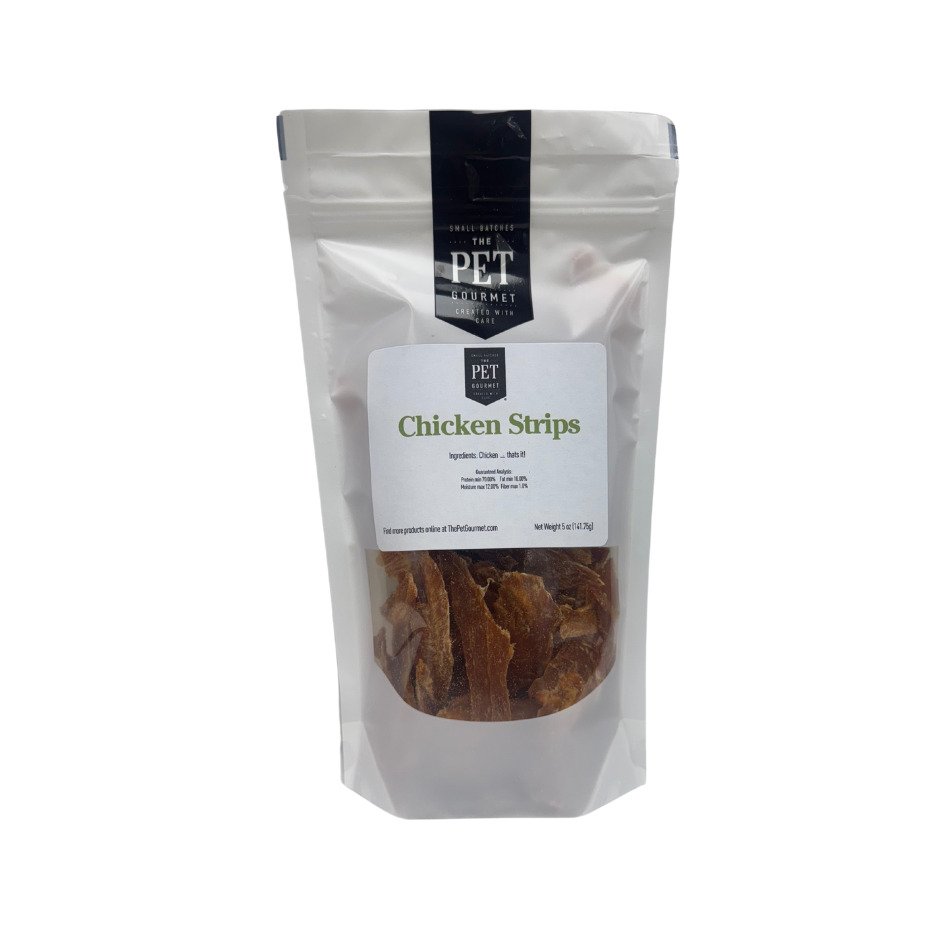
The dry, crunchy texture snaps when bent, so you can break one strip into training-sized pieces without a knife. That matters more than it sounds: smaller pieces mean smaller portions, and portion control is half the digestion battle.
Best for: dogs with suspected protein sensitivities and owners who want a label they can read in three seconds. Skip if: your dog has dental issues or refuses hard textures.
Single-ingredient treats can help with food sensitivities because fewer ingredients can make a trigger easier to isolate. Chicken is a common allergen, so a single ingredient is only useful if it is the right single ingredient for your dog.
Beef, Liver and Air-Dried Options for Sensitive Stomachs
Beef and liver jerky suit dogs that have already failed a chicken trial, while air-dried options fit owners who want a softer chew. Our Beef Liver Jerky Strips for Dogs - 5 oz use one ingredient, USA-sourced dried beef liver, at $17.99 with 69% minimum crude protein.

Liver is a dense source of vitamin A, iron, and B vitamins, which is why it works well as a small, high-value training reward rather than a free-fed snack. Liver's strong taste and rich nutrient load can be potent, so start with a small piece and watch stool quality before increasing.
Beef muscle jerky behaves differently from liver. It is leaner and chewier. The beef and carrot jerky runs $7.99 with a soft, chewy texture and about 31 calories per treat. The chicken and sweet potato version sits at $7.99 and roughly 22 calories per treat, which makes it the easier one to fit into a daily calorie budget. Both are multi-ingredient formulas, so they are a better fit for a dog with a stable stomach than for one mid-elimination-diet.
Air-dried jerky occupies a middle ground. The Wisdom line, including turkey, chicken, and a from-the-sea blend, is air-dried low and slow for a soft, chewy strip at $11.99 to $12.99 per 4 oz bag. Air drying removes moisture at a lower temperature than conventional oven drying, which preserves a softer texture and makes the strip easier to tear for small dogs and seniors. These formulas carry more ingredients, including quinoa and coconut glycerin. Coconut glycerin is a humectant that keeps the strip pliable.
The protein source and the number of variables can both be factors for a sensitive gut. A single-ingredient beef liver strip gives you one variable. A six-ingredient beef and carrot jerky gives you six. The single-ingredient option can be easier to test.
How to Read an Ingredient Label and Assess Digestibility Claims
No regulatory definition exists for "easy to digest" on a dog treat label. What you can verify is the ingredient list, the guaranteed analysis, and the calorie statement.
Run this checklist before you buy:
5 oz Chicken and Sweet Potato Jerky →
- First ingredient is a named meat
- Consider the ingredient count for a sensitive-stomach dog
- No artificial colors, flavors, or preservatives listed
- Protein percentage is listed
- Calories per treat are printed, not just per kilogram
- Protein source is stated
- Bag size and price per ounce make sense for your treat frequency
For a deeper walkthrough, read our guide to telling if dog treats are natural.
Watch out: a "grain-free" or "limited ingredient" badge are formulation categories, not digestion guarantees.
Safe Serving Sizes, Feeding Frequency and Transitioning to a New Treat
Treats should make up no more than about 10% of a dog's daily calories, a guideline the WSAVA global nutrition guidelines also uses when assessing complete diets. With jerky averaging 284.4 kcal per 100 g, that budget translates into a concrete number of grams per day by dog size. The table below uses a moderate activity level and a typical maintenance calorie estimate; adjust up or down based on your dog's body condition score.
| Dog size | Approx. weight | Est. daily calories | 10% treat budget | Jerky allowance (at ~284 kcal/100 g) |
|---|---|---|---|---|
| Toy | 5-10 lb | 200-350 kcal | 20-35 kcal | 7-12 g (about 1-2 strips) |
| Small | 10-25 lb | 350-700 kcal | 35-70 kcal | 12-25 g (about 2-4 strips) |
| Medium | 25-50 lb | 700-1,200 kcal | 70-120 kcal | 25-42 g (about 4-7 strips) |
| Large | 50-90 lb | 1,200-1,900 kcal | 120-190 kcal | 42-67 g (about 7-11 strips) |
| Giant | 90+ lb | 1,900-2,800 kcal | 190-280 kcal | 67-98 g (about 11-16 strips) |
These are starting points, not prescriptions. A 10 kg dog eating 700 kcal daily has roughly 70 kcal of treat budget, which is about 25 g of jerky. When in doubt, ask your veterinarian to calculate a daily calorie target and subtract the treat portion from it.
Feeding frequency can be considered alongside portion size. Small pieces can slow the rate of intake.
Transition slowly. Give one small piece on day one, watch for any changes, then increase gradually. Stop immediately if you see vomiting, diarrhea, or itching.
Consider changing one variable at a time, and keep a simple log of date, treat, and amount.
For a deeper walkthrough on fitting treats into a daily diet, read our guide to telling if dog treats are natural.
A Simple Homemade Dog Jerky Recipe and Food-Safety Risks to Know
A homemade dog jerky recipe can use one ingredient: thinly slice a boneless chicken breast or lean beef cut, bake until fully dried and firm, then cool completely before storing. No salt, no seasoning, no marinade.
Consider food-safety rules. Never use raw poultry juice on surfaces that touch human food. Refrigerate or freeze homemade jerky. And skip the garlic and onion that human jerky recipes call for, because both are toxic to dogs.
Commercial jerky carries its own risks. The FDA has investigated illnesses linked to jerky treats since 2007, and researchers have documented acquired Fanconi syndrome, a kidney disease associated with jerky-treat ingestion in dogs, in a published case study on jerky-associated Fanconi syndrome. That is not a reason to avoid jerky entirely. It is a reason to buy from sellers who name their protein source and publish full ingredient lists.
Build a Sensitive-Stomach Treat Box at K9 Kremery
Building a treat rotation beats buying one big bag. Start with a single-ingredient protein, add a soft-textured option for training, and keep portions small enough that treats stay under 10% of daily calories.
At K9 Kremery, we stock single-ingredient chicken and beef liver strips, soft chicken and sweet potato jerky, and air-dried turkey options, all orderable online with no subscription required. If you are still narrowing down what suits your dog, our guide to the best natural treats for sensitive dogs pairs well with a starter box.
Frequently Asked Questions
What ingredients should I avoid in jerky treats for dogs?
Skip treats with artificial colors, artificial flavors and unnecessary preservatives, and watch for added sugar or cane molasses. Single-ingredient options such as dried chicken breast or dried beef liver can be a good choice.
How do I introduce a new jerky treat to a dog with a sensitive stomach?
Start with one small piece, and give nothing else new that day. Watch for any changes. If your dog tolerates it, increase gradually to the labeled portion rather than free-feeding from the bag. A 2024 review in Frontiers in Animal Science put jerky at roughly 284 kcal per 100 g, so a 10 g strip is about 28 calories.
Is chicken jerky good for dogs with food sensitivities?
It can be, provided the chicken is the only ingredient. Single-protein treats can be a good option. K9 Kremery's Chicken Jerky Strips are made with USA-sourced chicken breast at 70% minimum crude protein, and the dry, crunchy strips snap into small training pieces.
Can I make a homemade dog jerky recipe safely?
Yes, use lean meat you would eat yourself and dry it thoroughly. Slice chicken breast or lean beef into thin strips, then dry until the strips are dry and snap when bent. Never add salt, garlic, onion or seasoning, and wash hands and surfaces after handling raw meat.
Most owners cycling through jerky bags are guessing at the cause. Start with one protein, one texture, and a written record of what changed. Browse the K9 Kremery jerky collection, order online today, and build a treat box around the protein your dog actually tolerates.
